
 Luxury Phinisi Editorial Desk
Updated: July 2026
Yes — modern luxury phinisi yachts carry Wi-Fi, and the best fleets now run Starlink satellite internet that works across Komodo, Raja Ampat, and open Indonesian waters. Expect speeds fast enough for video calls, streaming, and cloud work on Starlink-equipped vessels, while older boats relying on 4G lose signal once you sail beyond island cell towers. Here is exactly what to expect before you book.
Connectivity has quietly become one of the first questions U.S. travelers ask us — often before cabins or itineraries. That makes sense: a seven-night charter in Komodo or Raja Ampat is a long time to be unreachable if you run a business, have children checking in, or simply want to post from the deck. Luxury Phinisi has operated Starlink-equipped charters since the service reached Indonesian waters, and the difference between satellite and cellular connectivity at sea is larger than most guests expect. This guide explains both, destination by destination.
The Short Answer: Yes on Modern Fleets
Nearly every phinisi built or refitted in the last few years offers onboard Wi-Fi. The real question is what powers it. There are two systems in use across Indonesian charter fleets:
- Starlink satellite internet — a low-earth-orbit satellite dish mounted on the deck or wheelhouse roof. Coverage is continuous across Indonesian waters, including open crossings far from any island. This is the standard on premium and flagship charters.
- 4G/LTE routers — a marine router with local SIM cards (usually Telkomsel) that pulls signal from land-based towers. Works well near ports and populated islands, drops to nothing on open water and in remote anchorages.
When you inquire about any vessel in our phinisi fleet, ask specifically whether the boat carries Starlink or 4G-only. The two produce completely different experiences once you leave the harbor, and the answer should shape which vessel you choose — especially if you plan to work aboard.
Starlink vs 4G at Sea: Coverage by Destination
Indonesian charter grounds vary enormously in cellular coverage. Komodo National Park sits close to Labuan Bajo and Flores, so 4G reaches parts of it. Raja Ampat is another story entirely — hundreds of islands spread across a remote corner of West Papua, most of them without a single tower. The table below summarizes what each system realistically delivers.
| Location | Starlink | 4G/LTE (local SIM) |
|---|---|---|
| Labuan Bajo harbor | Excellent | Excellent |
| Komodo National Park (central anchorages) | Excellent | Patchy — 1–2 bars in some bays, dead zones behind islands |
| Open water, Flores Sea crossings | Excellent | None |
| Sorong / Waisai (Raja Ampat entry ports) | Excellent | Good |
| Raja Ampat central lagoons (Wayag, Misool) | Excellent | None to minimal |
| Banda Sea / remote transit routes | Excellent | None |
The pattern is simple: 4G is a harbor amenity; Starlink is genuine at-sea internet. In our experience, Starlink aboard a phinisi typically delivers download speeds comparable to a decent home connection — more than enough for simultaneous video calls, cloud syncing, and streaming in the saloon. Weather can briefly degrade the signal during heavy squalls, and the dish needs a reasonably clear view of the sky, but outages measured in minutes, not hours, are the norm.
Which Phinisi Carry Starlink
Across the market, Starlink installation tracks closely with charter tier. Here is how it maps to the per-night, all-inclusive full-boat rates you will see quoted for Indonesian phinisi charters:
| Tier | Size / Guests | Nightly Rate | Connectivity Norm |
|---|---|---|---|
| Entry | 20–25m, 4–8 guests | $3,500–5,500 | 4G router standard; Starlink increasingly common |
| Premium | 25–35m, 6–12 guests | $5,500–12,000 | Starlink on most vessels |
| Ultra | 35–50m, 8–14 guests | $12,000–20,000 | Starlink standard |
| Flagship | 50–65m, 12–16 guests | $20,000–35,000 | Starlink standard, often with boosted onboard network |
Komodo charters start from $3,500 per night; Raja Ampat, being far more remote, starts from $5,500 per night — and it is exactly in Raja Ampat where Starlink matters most, because there is no cellular fallback once you sail north of Waisai. If connectivity is a hard requirement for your trip, tell us when you inquire and we will only propose Starlink-equipped vessels. For teams planning offsites or board retreats afloat, our corporate phinisi charter service treats verified connectivity as part of the vessel-selection brief, not an afterthought.
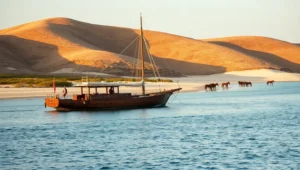
One note on heritage and hardware living together: these are traditional two-masted hulls built by Konjo shipwrights in Bira and Tana Beru, South Sulawesi — a boat-building craft recognized by UNESCO in 2017 — carrying ironwood and teak structures that predate the satellite era by centuries. A Starlink dish bolted above a hand-built ulin deck is the whole proposition of a modern phinisi charter in one image: the heritage hull, the current-generation navigation, safety, and communications equipment layered on top.
Air-Conditioning, Power and Charging Aboard
The second half of the “phinisi boat with AC and Wi-Fi” question is climate and power, so let us settle it. On modern charter phinisi:
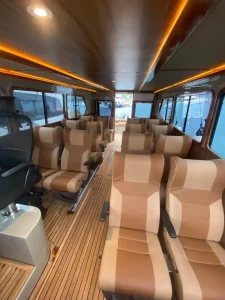
- Air-conditioning is standard in all cabins on entry-tier boats and above. Most vessels run cabin AC through the night; saloon and indoor dining areas are typically air-conditioned as well on premium tiers and up.
- Power is generator-supplied, usually 220V with Indonesian two-pin (European-style Type C/F) sockets. U.S. guests should bring a plug adapter; most laptop and phone chargers handle 220V natively, so a voltage converter is rarely needed.
- Charging points are fitted in every cabin, and many newer boats add USB ports at the bedside. Camera crews and dive photographers with heavy charging needs should flag this in advance so the crew can plan generator hours.
Generators typically run around the clock on ultra and flagship vessels. On smaller boats, some captains schedule quiet hours where the generator load is reduced — worth confirming if you depend on CPAP machines or overnight equipment charging. This is a standard question we handle during vessel matching; message us on WhatsApp at +62 811 382 3875 and we will confirm the exact power arrangement for any boat you are considering.
Working, Streaming and Video Calls Mid-Ocean
What can you actually do with Starlink aboard? Based on real charters, comfortably:
- Video conferencing. Zoom, Teams, and Meet calls hold up well, including screen sharing. Latency on low-earth-orbit satellites is low enough that conversations feel normal, not satellite-phone delayed.
- Cloud work. Google Workspace, Office 365, Slack, email, and file syncing all run as they would at a decent café. Large uploads (raw video, big design files) work but are best scheduled rather than assumed.
- Streaming. Netflix or YouTube in the saloon on a rain-shower afternoon is no problem. Bandwidth is shared across the boat, so a 14-guest charter streaming on six devices at once will feel it.
- Navigation and family contact. WhatsApp calls home, kids’ check-ins, and live location sharing all function throughout the itinerary.
A practical tip: the strongest signal is usually on the upper deck near the dish, and the weakest in lower-deck cabins with dense ironwood between you and the router. Crews position access points to cover shared spaces first. If you are planning to run a genuine workweek from the boat — morning calls with New York, afternoon dives — read our detailed guide to working remotely from a phinisi charter, which covers time-zone strategy, itinerary pacing for meeting schedules, and what to put in your pre-charter brief.
When to Embrace Going Offline
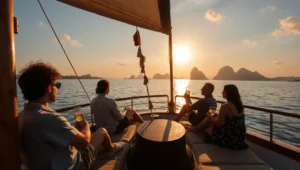
Having said all of this: some of the best hours of a phinisi charter happen when the phone stays in the cabin. Manta feedings at Karang Makassar, a dawn climb on Padar, the bioluminescence off the stern after dinner — none of these improve with a notification layer on top. Starlink means you are connected by choice rather than cut off by geography, and that distinction is the real luxury. Many of our guests set a simple rhythm: connected for an hour after breakfast and an hour before dinner, offline in between. The crew will happily support whatever balance you want, including switching the guest network off entirely on request. Families in particular tell us the enforced-optional offline time becomes the trip’s highlight.
FAQ: Connectivity Aboard
Do luxury phinisi yachts have Wi-Fi in Komodo?
Yes. Starlink-equipped phinisi have continuous internet throughout Komodo National Park and on crossings, while 4G-only vessels get patchy signal near Labuan Bajo and lose it in remote anchorages. Confirm which system a specific boat carries before booking if connectivity matters to your trip.
Is Starlink on a phinisi fast enough for video calls?
Yes. Low-earth-orbit satellite latency is low enough for natural-feeling Zoom, Teams, and Meet calls, including screen sharing. Heavy squalls can briefly degrade the signal, but interruptions are usually measured in minutes. Bandwidth is shared boat-wide, so coordinate with other guests during peak call times.
Is there internet on a Raja Ampat liveaboard?
Only reliably via Starlink. Cellular coverage in Raja Ampat is limited to the entry ports of Sorong and Waisai; the central lagoons around Wayag and Misool have essentially none. Raja Ampat charters start from $5,500 per night, and we recommend Starlink-equipped vessels there without exception.
Do phinisi boats have air-conditioning and charging in cabins?
Yes. Modern charter phinisi have air-conditioned cabins with 220V power points (bring a plug adapter for U.S. devices) and usually bedside USB ports. Generator schedules vary by vessel, so mention overnight equipment like CPAP machines when you inquire and we will confirm the arrangement.