
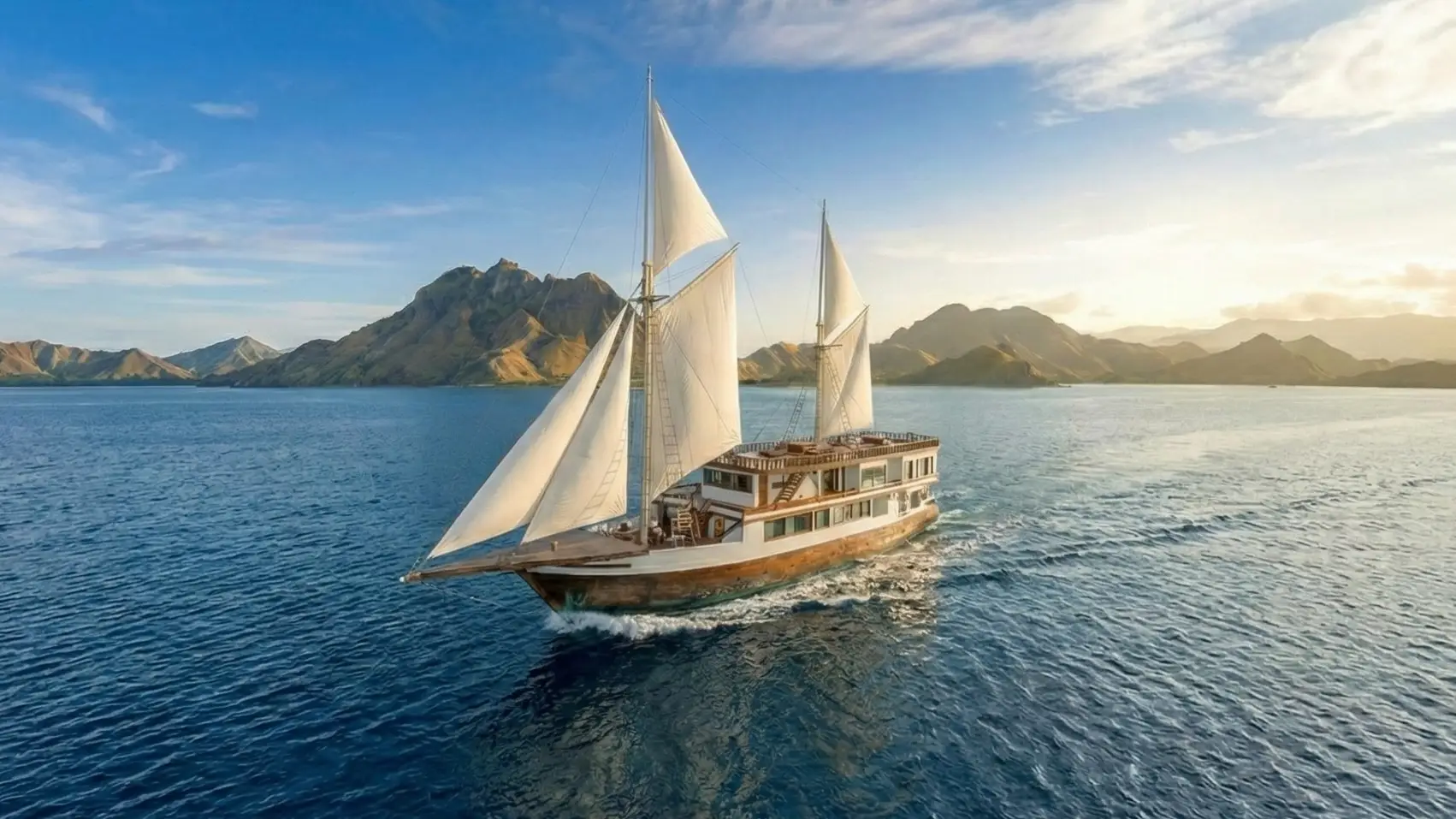
UNESCO Heritage of the 700-Year Buginese Yacht
Phinisi History
The complete history of the phinisi yacht — from 14th-century Buginese cargo vessel to UNESCO-recognized intangible cultural heritage in 2017. How phinisis are built, why they cannot be replicated, and what UNESCO recognition means for travelers.
The phinisi is the only luxury sailing yacht in the world built using a UNESCO-recognized intangible cultural heritage technique. Inscribed in 2017 on the UNESCO Representative List of the Intangible Cultural Heritage of Humanity, the phinisi shipbuilding tradition of South Sulawesi represents over 700 years of continuous maritime craft — passed master to apprentice, generation to generation, without blueprints, manuals, or shipyards. Phinisi heritage (UNESCO ICH)
Understanding the phinisi means understanding why it is fundamentally different from any other yacht you can charter. This is the full history of the boat you will sail aboard.
Luxury Phinisi is a curated Indonesia luxury tourism experience offered by Luxury Phinisi: Private Yacht Charters in Bali & Komodo: handpicked routes, vetted operators, transparent pricing, and 24/7 concierge support across Indonesia.
- What makes Luxury Phinisi a premium experience.
- How Luxury Phinisi: Private Yacht Charters in Bali & Komodo curates exclusive access and concierge logistics.
- Routes, seasons, and pricing transparency — no hidden fees.
The Origins
Origins: The Buginese and Konjo Maritime Heritage
The phinisi tradition emerged among two related ethnic groups of South Sulawesi: the Bugis (Buginese) and the Konjo. Both peoples developed their seafaring traditions in response to the geography of the Indonesian archipelago — over 17,500 islands separated by deep, current-driven seas, where survival and prosperity depended on the ability to sail confidently across long open-water passages.
The earliest forms of what would become the phinisi appeared no later than the 14th century. By the 17th century, Buginese sailors aboard phinisi-style cargo vessels had established trade networks reaching from the Spice Islands of Maluku in the east, to the Malay Peninsula in the west, to the northern coast of Australia in the south, and as far as Madagascar. Buginese maritime cartography of this period is among the earliest detailed sea charts produced in Southeast Asia.
The phinisi rig itself — two masts, seven sails (typically: three jibs, two main sails, two top sails) — is the configuration the boats settled into during the 19th century, balancing the cargo demands of the spice and copra trades with the wind conditions of the tropical Pacific. The seven-sail count is the source of the name: phinisi derives from panissi, a reference to the rig configuration.
Craftsmanship
How a Phinisi Is Built — The Living Tradition
What makes the phinisi heritage so unusual is not the boat itself, but the way it is built. There is no shipyard, no blueprint, no naval architect. There is only the master shipwright — the punggawa — who holds the design entirely in his memory.
The Beach Construction Tradition
Phinisis are built on the beaches of Tana Beru, Bira, and Lemo-Lemo in the Bulukumba regency of South Sulawesi. The boats are laid down on sand, not in a covered shipyard, in the open air. The keel is set during ceremonial dates aligned with the lunar calendar — the katto ceremony marks the laying of the first plank, and the entire build begins with a series of blessings from local imams and traditional Buginese ceremonies invoking ancestral protection.
A 30-meter luxury phinisi takes 12 to 18 months to build. A 50-meter flagship vessel like Lamima or Prana by Atzaró requires 24 to 36 months and a team of up to 50 craftsmen. The materials are entirely local: ironwood (kayu besi) for the hull, teak (kayu jati) for the deck and trim, and wooden pegs (pasak) joining the planks. The traditional phinisi uses zero metal fasteners in the primary structural frame.
The Master Shipwright (Punggawa)
The punggawa is the single individual responsible for the entire vessel design. He learned the craft from his father or his master shipwright over a decade of apprenticeship beginning in adolescence. He has built dozens of boats, and each new boat is shaped and proportioned by eye, by chalk lines on raw wood, and by adjustments made in real time as the hull takes shape.
This is not romantic exaggeration. The phinisi is one of the last large vessel traditions in the world that operates entirely without formal blueprints. UNESCO recognized this specifically as the basis for the 2017 inscription: the knowledge of phinisi shipbuilding is held in the master shipwrights, transferred through apprenticeship, and exists nowhere else.
Ceremonial Elements
Several stages of construction involve formal ceremonies passed down for centuries:
- Annaung Bangun — the laying of the keel, blessed by local elders.
- Annattara — the placement of the bow stem, considered the boat's most sacred element.
- Maccera Lopi — the launch ceremony, including offerings of red rice, banana leaves, and traditional foods to the sea.
For a UNESCO-listed cultural practice, these are not performances staged for tourists. The shipwrights perform them privately, as their fathers and grandfathers did, regardless of whether anyone is watching.
The Evolution
From Cargo Vessel to Luxury Yacht
Through the Early 20th Century
1970s – 1990s
The Last 15 Years
Today
Heritage of Humanity
UNESCO Recognition (2017)
On December 7, 2017, the UNESCO Intergovernmental Committee for the Safeguarding of the Intangible Cultural Heritage inscribed “Pinisi, art of boatbuilding in South Sulawesi” on the Representative List of the Intangible Cultural Heritage of Humanity. The inscription was the result of a multi-year nomination by the Indonesian government recognizing the cultural significance of the phinisi tradition.
The UNESCO file specifically recognizes:
- The phinisi as a continuing living tradition rather than a historical practice.
- The role of master shipwrights as custodians of the knowledge.
- The ceremonial and spiritual dimensions of the construction process.
- The phinisi shipbuilding villages of Tana Beru, Bira, and Lemo-Lemo as cultural sites.
This recognition matters for travelers. It means that when you charter a luxury phinisi, you are not chartering a yacht with traditional aesthetics applied to a modern hull. You are chartering a vessel built using a UNESCO-recognized heritage technique that exists nowhere else on Earth.
Beyond Imitation
Why the Phinisi Cannot Be Replicated
Several luxury yacht builders in Thailand, Vietnam, and the Mediterranean have attempted to build phinisi-styled vessels — wooden two-masted yachts with phinisi rigs and silhouettes. None of these are phinisis.
The reason is simple: the phinisi tradition is the master shipwrights of South Sulawesi. The vessel is the visible product, but the craft is the people. Without a Bira-trained punggawa shaping the hull from memory on a Sulawesi beach, you have a wooden yacht with phinisi styling — not a phinisi.
This is the reason every vessel in our fleet is built in South Sulawesi by master shipwrights from the Bira tradition. There is no shortcut to the heritage.
Your Vessel
The Phinisi You Will Sail
Every vessel in our curated fleet is a true phinisi: built in South Sulawesi by master shipwrights, using ironwood and teak, in the traditional construction sequence. Modern luxury amenities — climate control, water filtration, satellite navigation, dive platforms, gourmet kitchens — are added during the finishing phase, after the hull and primary structure are complete in the traditional manner.
This means our boats meet international maritime safety standards (annual KSOP inspection, full marine insurance, satellite distress systems, life rafts, fire suppression) while preserving the heritage construction. The two are not in conflict. They reinforce each other.
Ashore in Sulawesi
Visiting the Boatbuilding Villages
Charters that include port calls in South Sulawesi can be extended to visit Tana Beru, Bira, or Lemo-Lemo — the active boatbuilding villages where new phinisis are still being constructed. These visits are not tourist attractions. They are working sites where master shipwrights and apprentices work daily on commissioned vessels.
If your charter route allows, we can arrange:
- Private guided tour of an active phinisi build site led by a master shipwright.
- Access to the boatbuilding ceremonies (when scheduled and culturally appropriate).
- Meeting with the master shipwright who built your charter vessel, where the connection is feasible.
For travelers who want to understand the boat they are sailing, this is one of the most powerful experiences in Indonesian tourism — and it is available only to charter guests with the right itinerary planning.
A Living Tradition
The Phinisi as Living Heritage
The most important thing to know about the phinisi is that it is alive. The shipwrights still build. The apprentices still learn. The ceremonies still happen. The boats still launch from beaches that have launched boats for 700 years.
When you charter a luxury phinisi, you are not visiting a heritage. You are participating in one. The chef cooking your dinner, the captain steering through the Komodo strait, the deckhand handing you a snorkel — they are part of the same living tradition that built the boat. The boat is not the experience. The boat is the access to the experience.
That, more than anything else, is what we mean when we say the phinisi deserves a different standard. It is not just a beautiful boat. It is the only one of its kind.
Begin Your Voyage
Sail With the Heritage
Every charter we operate is aboard a true phinisi, built in South Sulawesi by master shipwrights from the Bira tradition. We would be honored to plan yours.
Technical Reference
For the specification side of this story — how the hulls are raised in Bulukumba, the timbers used and documented build costs — see the build library at Phinisi Luxury: phinisi boat building and what is a phinisi.