 Luxury Phinisi Editorial Desk
Updated: July 2026
A day on a phinisi liveaboard runs from a 05:45 sunrise on deck to dinner under the stars, with two or three excursions — diving, dragon trekking, a private sandbar — set between chef-prepared meals, while a crew of about twelve quietly handles navigation, service, and safety. Here is one charter day, hour by hour, exactly as guests live it.
Most people asking what it is like on a phinisi liveaboard picture either a cramped dive boat or a floating hotel that never moves. A well-run luxury phinisi yacht charter is neither. It is a working sailing yacht — a hull of ironwood and teak built by Konjo shipwrights in South Sulawesi, a craft recognized by UNESCO in 2017 — fitted with modern navigation, Starlink connectivity, and cabins finished to five-star standards. The day below is drawn from a typical Komodo itinerary aboard one of the vessels in our fleet. Raja Ampat days follow the same rhythm at a slower, more remote tempo.
| Time | What happens | Where you are |
|---|---|---|
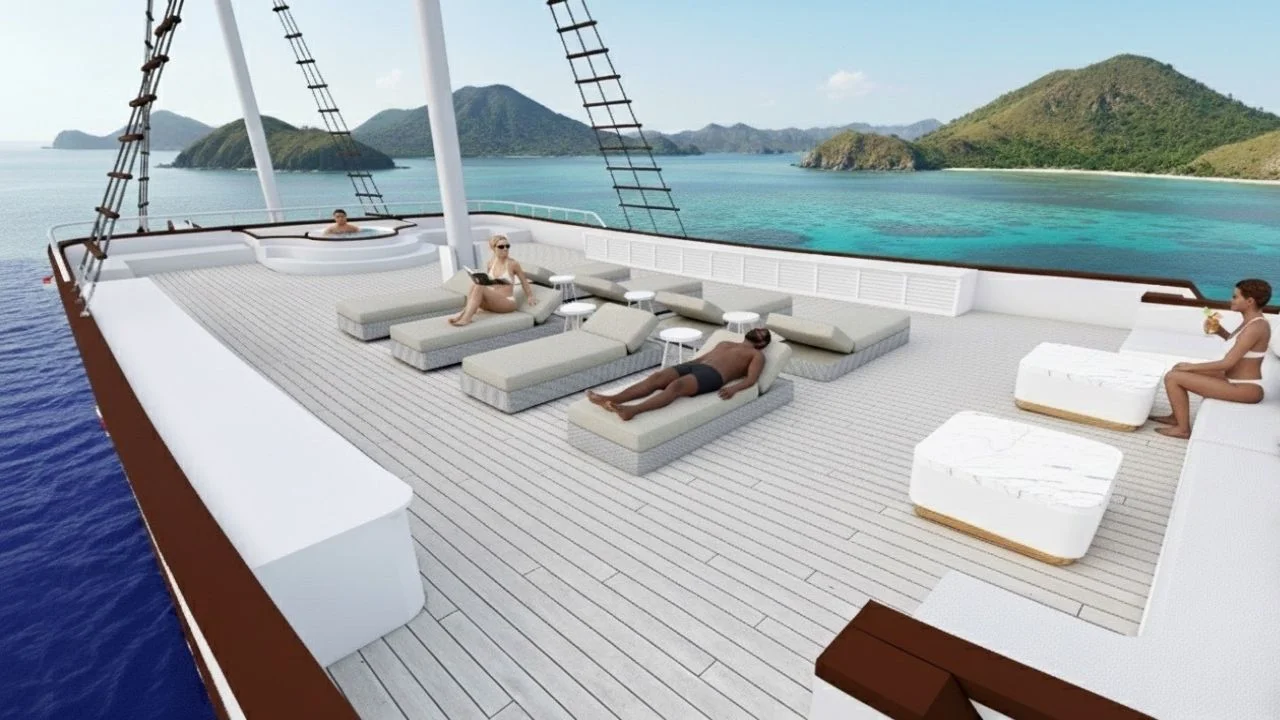
| 05:45 | Sunrise, coffee on the sun deck | At anchor, sheltered bay |
| 07:00 | Breakfast as the sails go up | Underway |
| 09:00 | First dive or Komodo dragon trek | Dive site / ranger station |
| 12:30 | Lunch on passage between islands | Underway |
| 15:00 | Kayaks, paddleboards, private sandbar | At anchor |
| 18:00 | Sunset ritual on the foredeck | At anchor |
| 20:00 | Dinner under the stars, night-sky navigation | Aft deck / sun deck |
05:45 — Sunrise Over the Anchorage
The generator hum is low and the bay is still. If you sleep with your cabin hatch cracked open, the first thing you hear is water against the hull; the second is the galley grinder starting on the day’s coffee. On deck, the steward has already set out a thermos, cups, and fruit for early risers. Nobody announces anything. Guests drift up one by one, wrapped in the deck blankets left folded on the daybeds the night before.
This half hour is, for many charterers, the reason they book a liveaboard rather than a resort. The anchorage was chosen the previous evening specifically for its east-facing aspect, so the sun comes up over the ridgeline of an uninhabited island and lights the rigging first, then the deck, then the water. Photographers should be on the foredeck by 06:00; the light stays soft for roughly forty minutes at these latitudes.
07:00 — Breakfast as the Sails Rise
Breakfast is served as the crew weighs anchor and, wind permitting, raises the sails for the morning passage. On a traditional two-masted phinisi rig this is a genuine spectacle — several crew hauling in coordination, canvas filling, the hull heeling a degree or two as she settles onto her course. The engines stay ready, but on a good reaching breeze the boat moves under sail alone, and the silence is total except for the water.
The table itself is set to order: eggs and pastries alongside Indonesian staples like nasi goreng and fresh tropical fruit, with the galley adjusting daily to preferences noted during your booking. Dietary requirements — vegetarian, halal, gluten-free, children’s menus — are confirmed before departure, not negotiated onboard. For a full picture of how meals work across a charter, our phinisi dining guide covers menus, provisioning, and how the chef plans around your route.
09:00 — First Dive / Dragon Trek
By 09:00 the yacht has reached the morning’s site and the day splits by interest. Divers gear up at the stern platform, where the dive team has already assembled and checked every set of equipment; the tender runs small groups to the entry point so nobody surface-swims against current. Komodo’s central sites reward this timing — visibility is typically best before midday, and current windows are planned around the tide tables, not guesswork.
Non-divers are usually ashore instead. On Komodo or Rinca, that means a ranger-led trek to see the dragons — the tender drops you at the station jetty, a licensed park ranger leads the walk, and the crew handles park permits and fees in advance so the morning involves zero paperwork. Treks run one to two hours depending on the loop you choose, and the light for wildlife photography is still workable at this hour.
Snorkelers get a third option: a drift along a reef shoulder near the anchorage, with a crew member trailing in the tender the entire time. This is standard practice, not an upgrade — on a private full-boat charter, every in-water activity has dedicated crew coverage.
12:30 — Lunch Underway Between Islands
Lunch is timed to the passage. While guests were diving or trekking, the captain planned the reposition to the afternoon anchorage — often ninety minutes to two hours of cruising through the straits between islands. The table is laid on the shaded aft deck, and the meal unfolds while the scenery moves: pink-sand beaches, savanna hills, the occasional pod of dolphins riding the bow wave if you are lucky with the season.
This is also the natural rest block of the day. Cabins have been made up during the morning excursion; air-conditioning is running; the saloon is quiet. Guests who want to work can — Starlink keeps the connection live even mid-passage, which is why a growing share of our charters now include at least one person on a partial working schedule. The rest nap, read, or claim a beanbag on the bow.
15:00 — Kayaks, Paddleboards and a Sandbar to Yourselves
The afternoon anchorage is chosen for shelter and shallows rather than dive access. As soon as the anchor sets, the crew launches the water toys: sea kayaks, stand-up paddleboards, snorkel gear rinsed and re-set from the morning. If the tide cooperates, the tender runs guests to a sandbar — a strip of white sand that exists for a few hours either side of low water, with no other boats and no footprints.
Families tend to structure this block loosely; the crew is flexible about running multiple tender shuttles, so grandparents can return to the yacht while teenagers stay out paddling. If you are planning your own trip, note that this is the block where sun exposure peaks — reef-safe sunscreen, rash guards, and a proper hat matter more here than anywhere else on the itinerary. Our checklist on what to pack for a phinisi cruise covers the full kit, from dive certification cards to what footwear actually works on a ranger trek.
18:00 — Sunset Ritual on the Foredeck
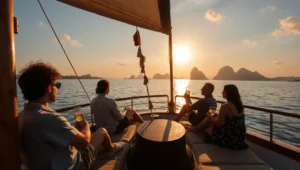
Around 17:30 the crew resets the foredeck: cushions arranged, canapés plated, drinks chilled. Sunset in the Flores Sea is fast — the sun drops in under twenty minutes this close to the equator — so the steward will quietly let you know when it is fifteen minutes out. On Komodo itineraries, some evenings this coincides with one of the park’s flying fox colonies leaving their mangrove roost: thousands of fruit bats crossing the darkening sky in a stream that lasts half an hour.
There is no forced program here. Some groups turn this into a nightly cocktail hour; honeymooners often ask for the foredeck to themselves; families with young children usually shift the ritual earlier and shorter. The crew reads the group and adjusts — that responsiveness is the practical difference between a private charter and a scheduled cruise ship timetable.
20:00 — Dinner Under the Stars, Night Sky Navigation
Dinner is the day’s longest meal, served on the aft deck under string lights or, on request, on the open sun deck under nothing but the sky. Menus lean on that morning’s provisioning — grilled fish bought from local suppliers, Indonesian courses alongside Western options — and the pacing is unhurried because there is nowhere else to be.
Afterward, the sky takes over. Komodo and Raja Ampat sit far from any city glow, and on a moonless night the Milky Way is visible from horizon to horizon. Ask the captain to walk you through it: phinisi crews descend from Bugis and Konjo seafaring communities that navigated these waters by the stars for centuries before GPS, and most captains can still point out the traditional reference stars. The yacht itself holds position on modern anchoring and radar watch all night — heritage above deck, current-generation safety systems below it.
What Your Crew Was Doing All Day (the Invisible 12)
Guests experience perhaps a third of the actual workday aboard. A typical crewed phinisi in the 25–35 metre class runs ten to fourteen crew, and their day looks like this:
- Captain and first officer: route planning against tide tables and weather, park permit coordination, anchor watches, and the constant radio traffic that keeps a national park itinerary legal and on time.
- Engineer: generator rotation, watermaker output, tender engines, air-conditioning — checked on a schedule, fixed before you notice.
- Dive team: filling tanks, testing regulators, scouting current on sites before guests enter the water.
- Chef and galley: three service meals plus canapés, baked fresh daily, provisioned from local markets at island stops.
- Stewards and deckhands: two full cabin services a day, deck washdowns at dawn, toy launches and recoveries, and the sail handling that makes 07:00 look effortless.
This staffing ratio — often close to one crew member per guest — is what the charter rate actually buys. Private full-boat pricing is all-inclusive per night: entry-class phinisi (20–25m, 4–8 guests) run $3,500–5,500; premium vessels (25–35m, 6–12 guests) run $5,500–12,000; ultra-class yachts (35–50m) run $12,000–20,000; and flagship phinisi (50–65m, 12–16 guests) run $20,000–35,000. Komodo charters start from $3,500 per night, while Raja Ampat starts from $5,500 per night owing to its remoteness. Since 2018, Luxury Phinisi has run these itineraries for U.S. and international travelers on vessels we charter, build, and manage ourselves — browse the fleet or message us on WhatsApp at +62 811 382 3875 to match a yacht to your dates.
Frequently Asked Questions
Do I have to follow this schedule on a private charter?
No. On a full-boat charter the itinerary is yours: the captain proposes a route built around tides and park rules, and everything else — wake-up times, meal hours, how many dives — flexes to your group. Scheduled departures on shared cabins follow a fixed program; private charters do not.
Is a phinisi liveaboard suitable for non-divers?
Completely. Every dive block has a parallel option — dragon trekking, snorkeling with crew escort, kayaking, or simply staying aboard. On most charters at least a third of guests never dive, and the crew plans excursions so divers and non-divers reconvene for every meal.
Will I have internet onboard?
Yes. Our vessels carry Starlink, which delivers a stable connection across Komodo and most of Raja Ampat, including on passage between islands. It is sufficient for video calls and remote work, though bandwidth is shared across the boat.
How rough is a night at anchor?
Generally very calm. Captains anchor in protected bays chosen for overnight shelter, and a phinisi’s heavy ironwood hull is notably stable at rest. Open-water crossings happen in daylight, and itineraries are sequenced around seasonal winds to keep passages comfortable.