 Luxury Phinisi Editorial Desk
Updated: July 2026
Food on a phinisi charter is prepared by a dedicated onboard chef who cooks three fresh meals a day, built around Indonesian seafood, market produce, and your stated preferences. On a Luxury Phinisi charter, menus are planned before departure, provisioned in island ports, and adapted daily — from grilled reef fish at sunset to a beach barbecue on a private sandbar.
Guests often assume that eating well at sea means compromise: limited ingredients, repetitive dishes, a galley doing its best. On a well-run phinisi, the opposite is true. The chef has access to some of the best seafood on the planet, a kitchen built for the boat, and a guest list of eight to fourteen people — a ratio most restaurants would envy. This guide explains exactly what you will eat on a luxury phinisi yacht charter, how menus are planned, and how dietary requirements are handled far from the nearest supermarket.
A Day of Meals at Sea
Every boat runs its own rhythm, but a typical charter day follows a recognizable pattern. Meals anchor the schedule the way dives and hikes anchor the itinerary — you will rarely wait for food, and you will rarely be rushed through it.
| Time | Meal | What to Expect |
|---|---|---|
| 06:30 | Light breakfast | Coffee, tea, fresh fruit, pastries — before an early snorkel or Padar sunrise hike |
| 09:00 | Full breakfast | Eggs to order, nasi goreng or mie goreng, tropical fruit plates, fresh juice |
| 13:00 | Lunch | Two to four dishes served family-style: grilled fish, vegetable curries, sambal, rice, salads |
| 16:00 | Afternoon snack | Fried banana, spring rolls, or fresh coconut after the day’s second activity |
| 19:30 | Dinner | The main event — multi-course, often on deck, timed to the anchorage and the sunset |
Portions are generous by design. Crews know that swimming, diving, and trekking build appetites, and running out of food between islands is not an option — so provisioning always errs on the side of abundance.
Your Private Chef: How Menus Are Planned
A phinisi yacht charter with chef is not the same as a boat with a cook. On full-boat charters in our Premium tier and above (from $5,500 per night, all-inclusive), the galley is run by a chef whose only job for the week is your table. Menu planning starts before you board:
- Preference sheet. During booking, you complete a form covering allergies, dislikes, spice tolerance, and any cuisine requests. This document drives the provisioning list.
- Menu draft. The chef builds a day-by-day framework — usually a rotation of Indonesian, pan-Asian, and Western dishes — leaving room for whatever the sea and markets provide.
- Daily check-ins. Most chefs or cruise directors will ask each morning what sounded good and what did not. Menus flex accordingly; nothing is locked in.
Indonesian dishes are usually the highlight. Expect ikan bakar (grilled fish with sweet-spicy glaze), rendang, gado-gado, satay grilled over charcoal on the aft deck, and sambals made fresh daily. Chefs calibrate heat to your tolerance — ask for it authentic and you will get it authentic.
Market-Fresh: Provisioning in Island Ports
Liveaboard food in Indonesia is only as good as its supply chain, and this is where routing matters. Charters departing Labuan Bajo for Komodo provision at the town’s morning market, where boats load reef fish, tuna, prawns, tropical fruit, and vegetables hours before departure. Longer itineraries — Raja Ampat, Banda, Alor — plan resupply stops at ports along the route.
Three practical consequences for guests:
- Seafood is genuinely fresh. Much of it was swimming within a day of reaching your plate. This is not a marketing line; it is how remote-island logistics work.
- Some ingredients are finite. Fresh dairy, specific imported cheeses, and delicate greens have limited life at sea. Chefs plan menus so the perishables peak early and hardier ingredients carry the back half of the trip.
- Special requests need lead time. A particular wine, a birthday cake, oat milk for your coffee — all possible, but they must be on the provisioning list before the boat leaves port. Tell us at booking, not at boarding.
The Seafood Ritual: From Line to Grill
Most phinisi crews fish. A hand line goes over the stern on passages between anchorages, and when it comes up with mahi-mahi or trevally, dinner changes. Guests are welcome to join — some of the best moments on a charter involve hauling in a fish at golden hour and eating it two hours later, grilled whole with lime, garlic, and sambal matah.
The grill itself is central to phinisi dining. These are wooden boats built by Konjo shipwrights from ironwood and teak — the same UNESCO-recognized boat-building tradition from Bira and Tana Beru in South Sulawesi — and their wide aft decks were made for open-air cooking. Charcoal-grilled fish, prawns, and squid appear on most dinner menus, usually alongside two or three composed dishes so non-seafood eaters never go without.
Dietary Requirements, Kids’ Menus and Celebrations
Dietary requirements on a liveaboard are handled well when they are communicated early, and poorly when they surface at the first dinner. Give us your requirements at booking and the chef will build the menu around them rather than working around them.
- Vegetarian and vegan: Straightforward. Indonesian cuisine has a deep vegetable and tofu-tempeh repertoire; vegan guests eat as well as anyone aboard.
- Gluten-free: Manageable with notice. Rice-based Indonesian cooking is naturally friendly here, but soy sauce and some sambals need substitution, so the chef must know in advance.
- Halal and no-pork: Standard practice on most Indonesian crews; simply confirm at booking.
- Severe allergies: Discuss directly with our team on WhatsApp (+62 811 382 3875) before confirming. Peanuts and shellfish are common in Indonesian kitchens, and cross-contamination protocols need to be agreed with the specific chef.
- Children: Chefs cook simpler, milder plates for kids — plain grilled chicken, pasta, fried rice without chili — and adjust meal times around naps if asked.
Celebrations are a specialty of charter crews. Birthdays, anniversaries, and proposals get cakes, decorated tables, and genuine crew enthusiasm. If you are planning a phinisi honeymoon charter, tell us — private dinners set apart from the main table, champagne breakfasts, and a candlelit beach setup are all standard requests the crew handles well.
Beach BBQs and Dining Under the Stars
At least once per charter, weather permitting, dinner moves off the boat entirely. The crew scouts a sandbar or empty beach in the afternoon, ferries the grill and tables ashore by tender, and sets up a barbecue under torchlight while you swim in from the anchorage. Grilled lobster or fish, satay, salads, and cold drinks, eaten with your feet in the sand on a beach with no one else on it — this is consistently the meal guests remember most.
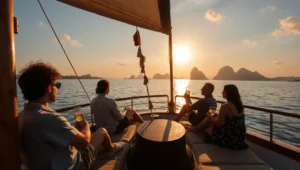
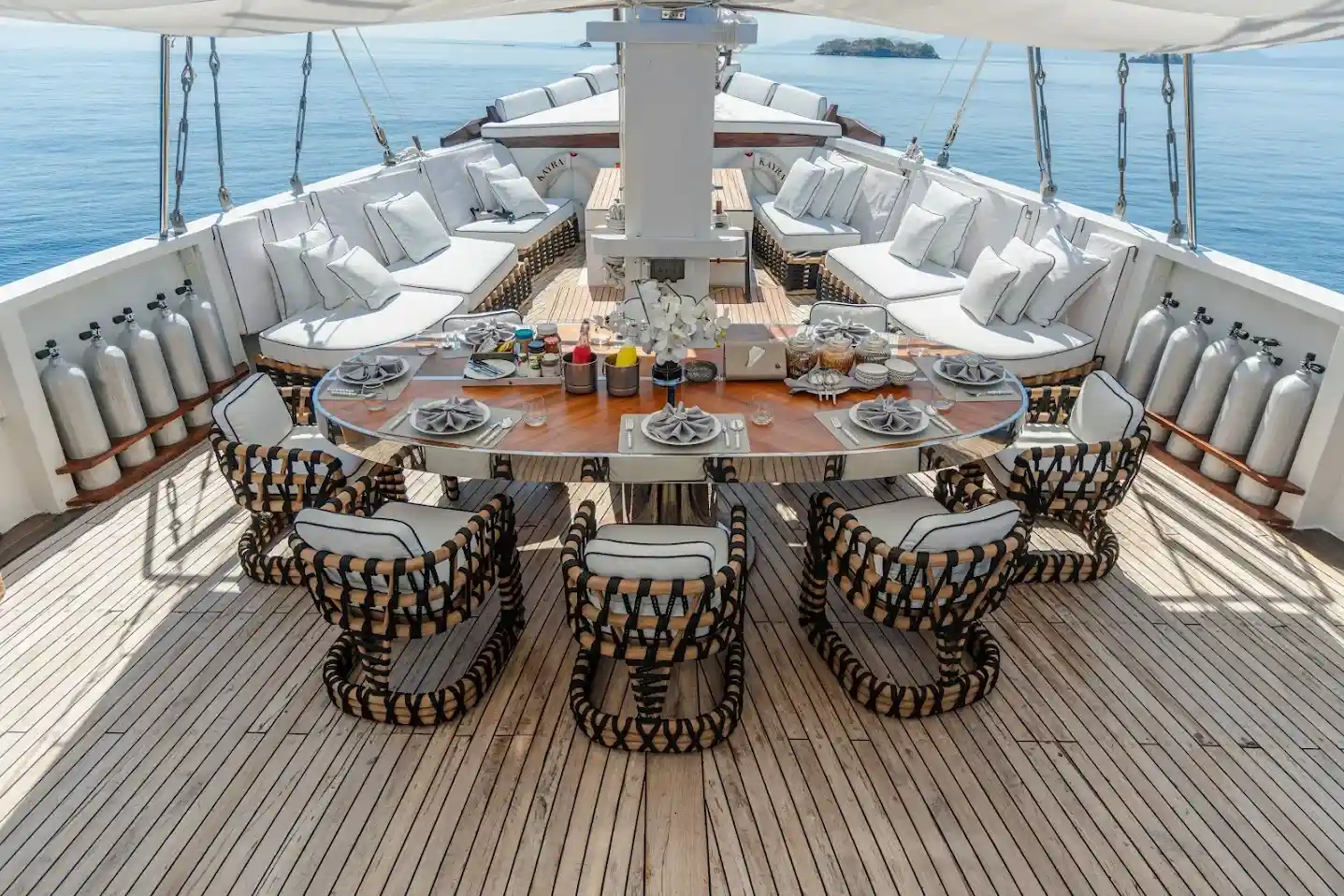
Back on board, dinner on deck is the default rather than the exception. Tables are set on the open aft deck or flybridge, and once the anchor is down and the generator hum fades, you eat under a sky with zero light pollution. For a fuller picture of how meals fit into the wider charter rhythm, see our guide to a full day onboard a luxury phinisi.
Wine, Cocktails and What’s Included
All Luxury Phinisi charters are full-boat and all-inclusive, and the galley reflects that: all meals, snacks, drinking water, coffee, tea, and soft drinks are covered in the nightly rate — Entry vessels from $3,500 per night, Premium $5,500–12,000, Ultra $12,000–20,000, and Flagship $20,000–35,000 for boats of 50 to 65 meters.
Alcohol policies vary by vessel and should be confirmed at booking. Common arrangements:
- Included selection: Many Premium and above vessels include beer and a house wine list in the charter rate.
- Provisioned to order: Specific wines, champagne, and spirits can be purchased ahead and stocked on board. Imported alcohol in Indonesia is heavily taxed, so expect prices above what you pay at home.
- Bring your own: Most boats allow guests to bring their own bottles, sometimes with a corkage arrangement — confirm before you fly.
Cocktails are a crew skill worth exploiting. A well-stocked Ultra or Flagship boat will have a crew member who takes sunset drinks seriously — fresh lime, young coconut, and good gin cover most requests. Espresso machines are standard on higher-tier vessels; if a proper flat white matters to you, ask which boats carry one.
FAQ
Is all food included on a phinisi charter?
Yes. Luxury Phinisi charters are all-inclusive: all meals, snacks, water, coffee, tea, and soft drinks are covered in the nightly rate, which starts at $3,500 per night for Entry-tier vessels. Alcohol arrangements vary by boat and are confirmed at booking.
Can the chef handle vegan, gluten-free, or allergy diets?
Yes, with advance notice. Vegetarian, vegan, halal, and gluten-free menus are routine when declared at booking. For severe allergies, we connect you with the operations team on WhatsApp (+62 811 382 3875) before confirming, so cross-contamination protocols are agreed with the specific chef.
How fresh is the seafood on board?
Very. Boats provision at island markets on departure day, and crews fish on passages between anchorages. Much of the fish served at dinner was caught the same day, either by the market fleet or off the stern of your own boat.
Can we request specific wines or a birthday cake?
Yes, if requested before departure. Specific wines, champagne, cakes, and specialty items go on the provisioning list at booking. Once the boat leaves port, resupply options are limited to what island ports along the route carry.