
 Luxury Phinisi Editorial Desk
Updated: July 2026
Choose Komodo for dragons, manta rays, and a shorter, lower-cost charter one hour from Bali; choose Raja Ampat for the richest coral reefs on earth and true remoteness. Komodo charters start at $3,500 per night and sail best April through November. Raja Ampat starts at $5,500 per night, runs best October through April, and rewards seven nights or more.
Both destinations sit inside Indonesia, both are protected marine parks, and both are best experienced from the deck of a private phinisi — the twin-masted wooden sailing yacht whose boat-building tradition in Bira and Tana Beru, South Sulawesi, was inscribed by UNESCO in 2017. Luxury Phinisi charters, builds, and manages these vessels across both regions, so we have no incentive to steer you toward one over the other. What follows is the honest comparison we give clients on the phone: season by season, dollar by dollar, reef by reef.
Ready to compare real routes and boats? Explore our Raja Ampat phinisi charter and Komodo phinisi charter pages for itineraries, seasons, and current rates.
The 50-Word Verdict
If you have four to five nights, want guaranteed drama above and below the waterline, and prefer a one-hour flight from Bali, book a Komodo phinisi charter. If you have seven nights or more, care most about reef quality and solitude, and don’t mind a longer journey east, book a Raja Ampat phinisi charter. There is no wrong answer — only a wrong season and a wrong trip length for each.
The two parks also solve different problems. Komodo compresses an extraordinary amount into a small area: dragons in the morning, a pink-sand beach at noon, manta rays before sunset, all within a few hours of cruising. Raja Ampat is the opposite — an archipelago of more than 1,500 islands spread across a vast stretch of West Papua, where the reward is scale, silence, and reefs that marine biologists treat as the global reference point.
Komodo vs Raja Ampat: Head-to-Head
| Factor | Komodo National Park | Raja Ampat |
|---|---|---|
| Best charter season | April – November (dry season) | October – April (calm seas) |
| Full-boat charter from | $3,500 per night, all-inclusive | $5,500 per night, all-inclusive |
| Getting there | About 1 hour by air, Bali to Labuan Bajo | 4–6 hours to Sorong, typically via Jakarta or Makassar |
| Minimum nights | 3 nights (4–5 recommended) | 7 nights (10–12 recommended) |
| Signature wildlife | Komodo dragons, reef manta rays | The most biodiverse coral reefs recorded anywhere; mantas, walking sharks, birds-of-paradise |
| Best suited to | Families, first-timers, honeymoons, mixed groups | Divers, serious snorkelers, photographers, repeat Indonesia travelers |
Two details in that table deserve emphasis. First, the seasons barely overlap — which matters enormously if your dates are fixed. A July charter points firmly to Komodo; a January charter points to Raja Ampat. Our guides to the best time to visit Komodo and the best time to visit Raja Ampat break both calendars down month by month. Second, the minimum-nights figures are not marketing. Komodo genuinely works in three nights. Raja Ampat genuinely does not in fewer than seven, because the distances between its four main regions — Dampier Strait, Wayag, Misool, and the central islands — consume real cruising time.
Above Water: Dragons and Pink Beaches vs Karst Lagoons
What Komodo looks like from the deck
Komodo National Park, a UNESCO World Heritage Site since 1991, is a landscape of dry savannah hills that turn gold in the dry season and drop straight into turquoise channels. The headline act is obvious: this is the only place on the planet where you can walk, with a ranger, among wild Komodo dragons — the largest lizard on earth — on the islands of Komodo and Rinca. No zoo enclosure reproduces the effect of a three-meter dragon crossing a trail twenty meters ahead of you.
The supporting cast is nearly as strong. Padar Island’s ridgeline offers the most photographed viewpoint in Indonesia — three curved bays in three different sand colors, best climbed at dawn before the heat arrives. Pink Beach earns its name from fragments of red organisms mixed into the white sand. Between anchorages, the park’s channels regularly deliver dolphins off the bow. A well-planned four-night itinerary covers all of it without ever feeling rushed.
What Raja Ampat looks like from the deck
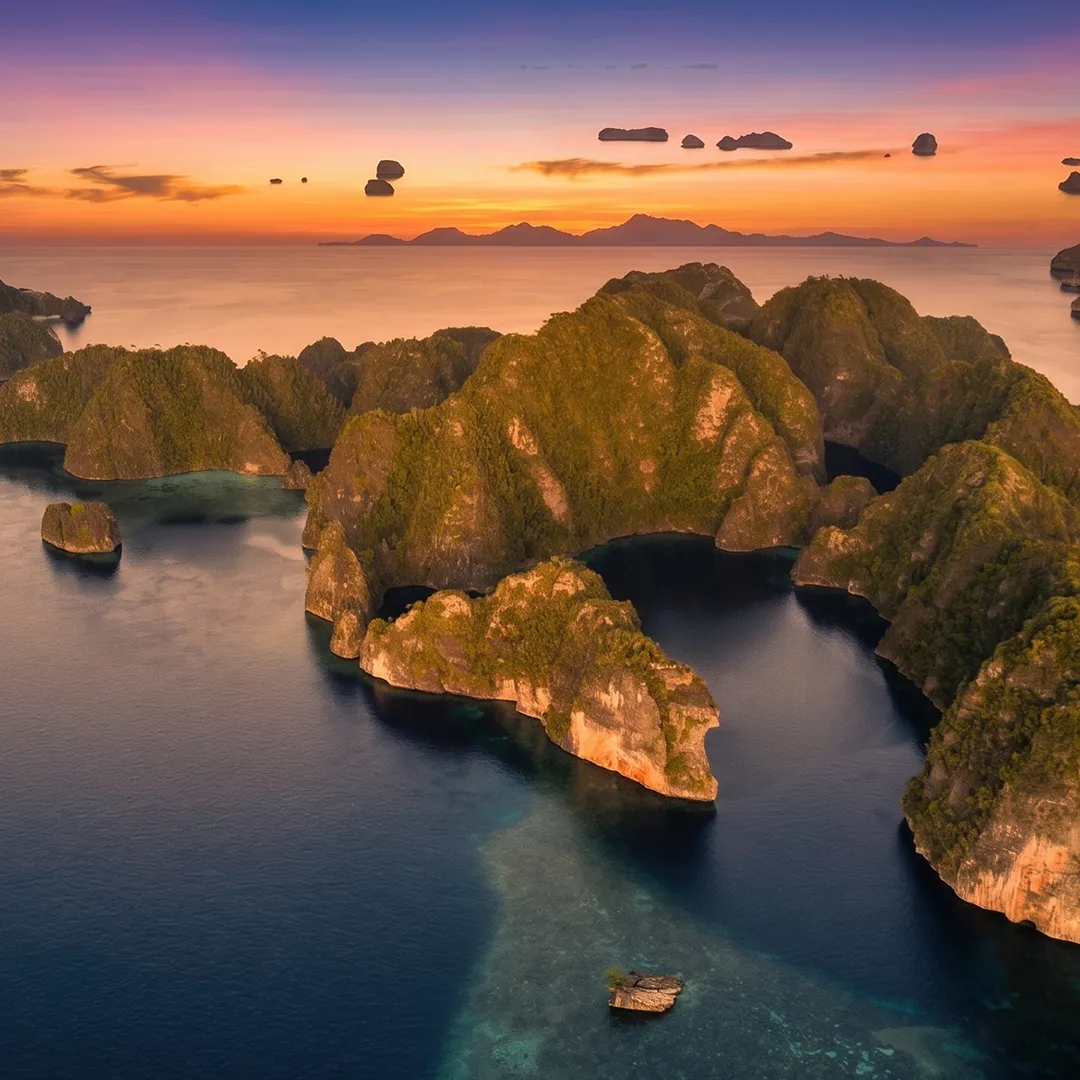
Raja Ampat trades Komodo’s dry drama for something stranger and greener: hundreds of mushroom-shaped karst islets rising out of lagoons so still they mirror the sky. The Wayag island group in the north and Piaynemo in the center are the archipelago’s icons — short, steep climbs reward you with views over turquoise mazes that look designed rather than formed. In the south, Misool’s lagoons, rock art, and jellyfish lake add a layer few first-time visitors expect.
Raja Ampat is also a birding destination of genuine consequence. Pre-dawn hikes from the beach lead to display trees of the red bird-of-paradise and Wilson’s bird-of-paradise, both endemic to these islands. Add sea-kayaking through mangrove channels, visits to Papuan villages, and beaches that may not see another vessel all day, and the above-water case for Raja Ampat is stronger than its diving-first reputation suggests.
Below Water: The Mantas of Komodo vs the Coral Epicentre
Komodo underwater: current, mantas, big animals
Komodo’s diving is defined by movement. Tidal currents squeeze between the islands, and those currents feed everything. Karang Makassar — better known as Manta Point — is a long drift over rubble where reef manta rays queue at cleaning stations, sometimes a dozen in a single pass. Batu Bolong, a pinnacle in the middle of the current, concentrates so much fish life on its sheltered side that first-time divers routinely call it the best single dive of their lives. Snorkelers are not left out: mantas at Karang Makassar and the shallows of Pink Beach are accessible without a tank.
The honest caveat: Komodo’s marquee sites are current-swept, and conditions can change within a single tide. Experienced dive guides — and a captain who reads the tide tables correctly — are not optional here. That is precisely why a private charter outperforms day boats: your schedule bends to the tides, not the other way around.
Raja Ampat underwater: the reference point for reefs
Raja Ampat sits at the epicenter of the Coral Triangle. Surveys in the Bird’s Head Seascape have recorded roughly 75 percent of all known coral species and more than 1,700 reef fish species — figures without parallel anywhere else in the ocean. At Cape Kri in the Dampier Strait, ichthyologist Dr. Gerald Allen counted 374 fish species on a single dive, a record that stood as a benchmark for the sport. This is not a destination with a few great sites; the baseline itself is extraordinary.
Beyond raw numbers, Raja Ampat offers range. Dampier Strait delivers fish storms and reef mantas; Misool’s protected marine reserve delivers soft-coral walls in colors that look saturated even before editing; macro sites hide pygmy seahorses and the walking shark, an epaulette species that strolls across the reef on its fins after dark. Water is warm year-round, and many of the best reefs top out at snorkel depth — a point non-divers consistently underestimate.
The Cost Difference, Explained
Every Luxury Phinisi charter is priced per night for the whole vessel, all-inclusive — crew, dive team, full board, and park logistics. The fleet spans four tiers:
- Entry (20–25m, 4–8 guests): $3,500–5,500 per night
- Premium (25–35m, 6–12 guests): $5,500–12,000 per night
- Ultra (35–50m, 8–14 guests): $12,000–20,000 per night
- Flagship (50–65m, 12–16 guests): $20,000–35,000 per night
Komodo charters start at $3,500 per night; Raja Ampat starts at $5,500 per night. The gap is structural, not arbitrary. Raja Ampat is roughly 1,400 kilometers further east, which means higher fuel and provisioning costs, longer crew rotations, and repositioning voyages to get vessels there in the first place. Itineraries are longer, so the total trip budget stretches further apart than the nightly rate suggests: a strong Komodo charter can land around $14,000–17,500 total for four to five nights on an entry-tier vessel, while a comparable Raja Ampat trip starts near $38,500 for seven nights.
One more budgeting note that surprises U.S. travelers pleasantly: because pricing is for the full boat, the per-person math improves fast with group size. Eight guests on a $4,500-per-night vessel pay well under $600 per person per night — with a private chef, dive guides, and an itinerary built around them — which compares favorably with shared luxury liveaboard cabins in either park.
Family, Honeymoon or Dive Group: Which Fits Which
Families: Komodo, decisively
The one-hour flight from Bali, short cruising legs, calm dry-season anchorages, and a wildlife encounter that thrills a nine-year-old as much as a grandparent make Komodo the family pick. Dragons, snorkeling with turtles, a beach barbecue, and Padar at sunrise fill four days without a single long passage. Raja Ampat’s travel day — often ten hours or more door-to-deck — tests younger children before the trip even begins.
Honeymoons: either, depending on the couple
Komodo suits couples who want maximum spectacle in a five-night window and perhaps a few days in Bali on either side. Raja Ampat suits couples for whom privacy is the point: anchorages with no other boat in sight, reefs to yourselves, and a slower rhythm that a ten-night itinerary allows. If the wedding calendar puts your honeymoon in July or August, Komodo’s dry season makes the choice for you; a December or January wedding points to Raja Ampat.
Dive groups: Raja Ampat first, Komodo for the current junkies
A group of certified divers chasing biodiversity, photography subjects, and back-to-back quality dives should choose Raja Ampat — the density of top-tier sites means less cruising and more diving. Groups who prize adrenaline over species counts, or who can only travel in the northern summer, will find Komodo’s drift dives and manta aggregations more than a consolation prize. Mixed groups of divers and non-divers do well in both, though Komodo’s shorter format keeps non-divers happier.
Still undecided?
Trip length is the cleanest tiebreaker. Under six nights: Komodo. Seven or more: both are open, and season decides. You can compare every region we operate — including Komodo, Raja Ampat, and beyond — on our Indonesian charter destinations page.
Do Both: The One-Year Two-Charter Plan
Here is the answer most comparison articles bury: the two parks have opposite peak seasons, which makes doing both within twelve months unusually practical. A pattern our repeat clients follow:
- June–September: Komodo. Dry season, golden hills, peak visibility windows, and dates that align with U.S. summer holidays. Four to five nights on an entry or premium vessel.
- October–November: decide and book. As phinisi reposition east for the Raja Ampat season, the best weeks for the following winter sell first. This is the moment to lock dates.
- December–March: Raja Ampat. Calm seas, manta season in the Dampier Strait, and ten nights of the finest reef diving on earth over the northern winter.
Booking both legs with one operator has compounding benefits: the crew already knows your dietary preferences, your dive profiles, and whether you want sunrise hikes or slow mornings. Because Luxury Phinisi builds and manages its own vessels — heritage ironwood and teak hulls from the Konjo shipwrights of South Sulawesi, refitted with modern navigation, safety systems, and Starlink connectivity — the standard you experience in Komodo is the standard that meets you in Sorong. We have arranged charters this way for U.S. travelers since 2018, and the two-park year remains the single most recommended itinerary we sell. To check dates for either park, message our charter team on WhatsApp at +62 811 382 3875.
Frequently Asked Questions
Is Raja Ampat better than Komodo for diving?
For reef biodiversity, yes — Raja Ampat’s recorded coral and fish counts are the highest on earth, and no destination matches its density of top-tier sites. Komodo counters with big-animal drama: drift dives, reef manta aggregations at Karang Makassar, and fish-packed pinnacles like Batu Bolong.
Can I combine Komodo and Raja Ampat in one trip?
In a single charter, rarely — the parks are about 1,400 kilometers apart and their peak seasons barely overlap. The practical approach is two charters in one year: Komodo between April and November, Raja Ampat between October and April, ideally with the same vessel operator.
Which is cheaper, a Komodo or Raja Ampat charter?
Komodo. Full-boat, all-inclusive charters start at $3,500 per night in Komodo versus $5,500 per night in Raja Ampat, and Komodo itineraries are shorter — four to five nights against seven or more. Total trip cost in Raja Ampat typically runs two to three times higher.
Do I need to be a certified diver for either destination?
No. Both parks rank among the best snorkeling regions anywhere, with mantas, turtles, and shallow reefs accessible from the surface. Raja Ampat in particular has world-leading reefs within snorkel depth, and our crews run separate snorkel and dive tenders so mixed groups never compromise.