
 Luxury Phinisi Editorial Desk
Updated: July 2026
The best time to visit Raja Ampat is October through April, when calm seas, 20–30 meter visibility, and peak manta activity align. The May–September southeast monsoon brings wind and swell to exposed southern sites, though sheltered northern anchorages remain sailable. For a private phinisi charter, book December–March departures nine to twelve months ahead.
Raja Ampat sits almost exactly on the equator, which means it never has a true dry season the way Komodo does. What changes through the year is not rain but wind — and on a sailing charter, wind is everything. It decides which dive sites are reachable, how comfortable your nights at anchor feel, and whether the crossing from Sorong to the Dampier Strait takes ninety smooth minutes or a lumpy afternoon. This guide breaks the year down month by month, explains how the seasons move charter pricing, and shows how to pair Raja Ampat with Komodo so a single year covers both archipelagos at their best.
Once your dates are set, follow our 7-day Raja Ampat itinerary day by day from Sorong to Misool.
The 30-Second Answer: October Through April
From October to April, the northwest monsoon dominates eastern Indonesia. In Raja Ampat this translates to light winds, low swell, and long windows of glassy water across the Dampier Strait — the channel that holds the region’s most famous dive sites, including Cape Kri, Blue Magic, and the manta cleaning stations near Arborek. Underwater visibility typically runs 20 to 30 meters, water temperature holds between 27 and 30°C year-round, and reef manta rays aggregate in numbers that make near-daily encounters realistic rather than lucky.
From May to September, the pattern reverses. The southeast monsoon pushes wind and swell up from the Banda Sea, exposing southern areas like Misool and making some open-water crossings uncomfortable. The northern Dampier Strait stays workable for much of this period, but many charter yachts — including most of the premium phinisi fleet — reposition to Komodo, where these same months are the peak season. If your dates are flexible, aim for the October–April window. If they are not, the Raja Ampat phinisi charter page covers which vessels remain in the region year-round and how routing changes by season.
Raja Ampat Weather by Month: Wind, Visibility, Manta Activity, Crowds
The table below summarizes sailing and diving conditions across the year. Treat it as a planning framework, not a forecast — equatorial weather moves in short cycles, and a rain squall in February clears as quickly as it arrives.
| Month | Wind & Swell | Visibility | Manta Activity | Crowds |
|---|---|---|---|---|
| January | Light NW winds, calm straits | 20–30 m | High | High (holiday spillover) |
| February | Calm, occasional squalls | 20–30 m | Peak | High |
| March | Calm, very settled | 20–30 m | High | Moderate |
| April | Transitional, light and variable | 15–25 m | Tapering | Moderate |
| May | SE monsoon building | 15–25 m | Low | Low |
| June | SE winds, swell in the south | 10–20 m, variable | Low | Very low |
| July | SE monsoon peak, exposed south | 10–20 m, variable | Low | Very low |
| August | SE monsoon peak, north sheltered | 10–20 m, variable | Low | Very low |
| September | SE winds easing late month | 15–20 m, improving | Returning | Low |
| October | Seas settling, transition to NW | 15–25 m | Building | Low–moderate |
| November | Calm, NW pattern established | 20–30 m | High | Moderate |
| December | Calm; brief holiday squalls | 20–30 m | High | Peak (festive weeks) |
Two clarifications on the numbers. First, “crowds” in Raja Ampat is relative — even in February, you will share major sites with a handful of liveaboards, not the flotillas seen in better-known destinations. On a private charter, your cruise director times dives to avoid other groups entirely. Second, visibility figures describe the Dampier Strait and central islands; Misool in the far south often exceeds these ranges during the calm season and falls below them when the southeast swell runs.
October to December: Manta Season Begins
October is the hinge of the Raja Ampat year. The southeast monsoon releases its grip, the straits flatten, and the first reef mantas return to the cleaning stations between Arborek and Mansuar. By November the pattern is fully established: morning dives at Cape Kri with barracuda and trevally schooling in the current, afternoons at Manta Sandy or Manta Ridge watching rays queue over the coral heads, evenings at anchor in water so still the Milky Way reflects off it.
For charter guests, October and November are arguably the smartest weeks of the entire season. Conditions are already excellent, the festive-season premium has not yet arrived, and yacht availability is at its widest because the fleet has just repositioned from Komodo. December delivers the same ocean with two caveats: the Christmas and New Year weeks book out furthest in advance and carry the year’s highest rates, and brief squalls become slightly more frequent — rarely enough to cost a dive, occasionally enough to reshuffle one.
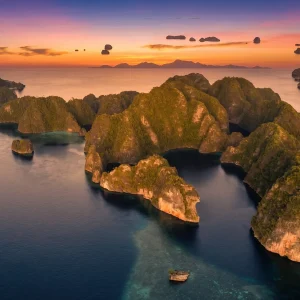
Photographers should note that October–December also brings the calmest surface conditions for Raja Ampat’s signature over-water imagery: the karst viewpoints of Piaynemo and Wayag are at their best when the lagoons below them sit mirror-flat in the early morning.
January to April: Peak Conditions
If you want the highest probability of perfect days, January through March is the answer. The northwest monsoon is fully settled, currents at the premier sites run predictably, and manta activity peaks — February in particular is known for large aggregations at the Dampier Strait stations and for oceanic mantas appearing at Blue Magic. Visibility regularly touches 30 meters at outer sites. This is also when Misool, the southern jewel of the archipelago, is most reliably reachable, with its ridges, sea fans, and dense soft-coral cover justifying the extra sailing hours.
January and February carry equatorial rain in short, heavy bursts, usually at night or early morning. It does not disrupt diving — the rain falls on a warm, flat sea — but travelers expecting cloudless skies every day should calibrate: this is a rainforest archipelago, and the green of its islands comes from somewhere.
March and early April are the connoisseur’s pick. Conditions remain at their peak, holiday crowds are gone, and rates soften slightly outside the festive window. A full southern loop taking in both the Dampier Strait and Misool fits comfortably into a week; the 7-day Raja Ampat itinerary shows exactly how those days sequence, anchorage by anchorage.
By late April the transition begins. Winds turn variable, and while the diving stays good, long-range planning gets harder. Charters still run — but experienced captains build more flexibility into the route.
May to September: Can You Still Go?
Yes — with adjusted expectations and the right vessel. The southeast monsoon does not close Raja Ampat; it narrows it. The northern Dampier Strait and the islands around Waigeo retain sheltered anchorages and diveable sites through most of the season. What changes is flexibility: southern crossings to Misool become weather-dependent, some exposed sites are off the table for days at a time, and surface intervals are spent reading the wind rather than ignoring it.
There are genuine arguments for the off-season. You will see almost no other boats. Homestay-supported sites feel like private reserves. And because most of the premium fleet has moved to Komodo, the vessels that remain often price aggressively. A traditionally built phinisi handles the season’s conditions well — these hulls were engineered by Konjo shipwrights for Indonesian trade winds long before tourism existed — but comfort at anchor still depends on an experienced captain choosing lees correctly.
Our honest guidance at Luxury Phinisi: if this is your one planned trip to Raja Ampat, hold out for October–April. If you are already in Indonesia between May and September and want remote-archipelago sailing at its quietest, a northern-route charter can be excellent — just accept that the itinerary will be written in pencil. Message us on WhatsApp at +62 811 382 3875 with your dates and we will tell you plainly whether they work.
How Season Affects Charter Prices
Raja Ampat charters start from $5,500 per night for a full-boat, all-inclusive booking — a floor set by the region’s remoteness: provisioning runs through Sorong, fuel and crew logistics cost more than in Komodo, and park permits apply per guest. From there, pricing follows vessel class rather than season alone:
- Premium class (25–35 m, 6–12 guests): $5,500–12,000 per night. The core of the Raja Ampat fleet — en-suite cabins, dedicated dive crew, full charter service.
- Ultra class (35–50 m, 8–14 guests): $12,000–20,000 per night. Larger owner’s suites, expanded toy inventories, higher crew-to-guest ratios.
- Flagship class (50–65 m, 12–16 guests): $20,000–35,000 per night. The largest sailing phinisi afloat, with spa facilities, multiple decks, and expedition-grade range.
Season moves these numbers in three predictable ways. First, the festive fortnight — roughly December 20 to January 5 — commands the year’s highest rates and frequently a seven-night minimum. Second, the shoulder months of October, November, and April offer the best value inside the good-weather window; identical vessels often quote 10–20% below their festive rates. Third, May–September pricing on vessels that stay in the region can drop meaningfully, reflecting the routing constraints described above. All figures are full-boat rates covering crew, meals, diving, and standard itinerary fuel — not per person.
One structural note: because Raja Ampat’s premium fleet is small and the season is only seven months long, the best vessels for February and the festive weeks are typically confirmed nine to twelve months out. Booking early costs nothing extra; booking late costs you the boat you wanted.
Pairing Raja Ampat with Komodo in One Year
The two flagship charter regions of Indonesia run on opposite calendars, and that is a gift to anyone planning a year of sailing. Komodo’s dry season — its prime window — runs roughly May through September, exactly when Raja Ampat is at its most difficult. Raja Ampat then takes over from October through April, while Komodo’s wet season brings rain and reduced visibility to Flores. The fleet itself follows this rhythm: many phinisi sail Komodo from May to September, then make the multi-day passage east to Sorong for the Raja Ampat season.
A well-planned year therefore looks like this: Komodo in June–August for dragons, currents, and manta rays at Makassar Reef, from $3,500 per night; Raja Ampat in January–March for the richest reefs on the planet, from $5,500 per night. The two experiences complement rather than repeat each other — Komodo is dry hills, big animals, and adrenaline drift dives; Raja Ampat is jungle karst, coral density, and biodiversity that marine scientists still measure in superlatives. Our Komodo vs Raja Ampat comparison breaks down which suits a first charter, and the best time to visit Komodo guide gives that region the same month-by-month treatment as this one.
Since 2018, Luxury Phinisi has planned both seasons for U.S. travelers as a single conversation — same charter consultant, same standards, one vessel shortlist per region. Every yacht we charter, build, sell, or manage carries the same lineage: ironwood and teak hulls from the UNESCO-recognized boatbuilding villages of Bira and Tana Beru in South Sulawesi (inscribed in 2017), refitted with modern navigation, safety systems, and Starlink connectivity so the remotest anchorage in the Dampier Strait still has working bandwidth.
Frequently Asked Questions
Can you visit Raja Ampat in July or August?
Yes, but with limits. The southeast monsoon brings wind and swell that restrict southern routes and exposed sites, so charters focus on the sheltered northern Dampier Strait and Waigeo. You will have the region nearly to yourself, though itineraries stay flexible and Misool is usually off the table.
When is manta season in Raja Ampat?
Reef mantas aggregate at the Dampier Strait cleaning stations from roughly October through April, with the densest activity from December to March. February is widely considered the peak month, when oceanic mantas also appear at sites like Blue Magic alongside the resident reef population.
How far in advance should I book a Raja Ampat charter?
Nine to twelve months for peak dates — February and the Christmas–New Year fortnight sell out first because the premium fleet is small and the season lasts only about seven months. Shoulder-season departures in October, November, or April can sometimes be arranged three to six months out.
Is the water cold in Raja Ampat during the off-season?
No. Water temperature holds between 27 and 30°C in every month, so a 3mm wetsuit or less is sufficient year-round. What changes seasonally is surface conditions and visibility, not temperature — the equatorial location keeps the sea consistently warm.