 Luxury Phinisi Editorial Desk
Updated: July 2026
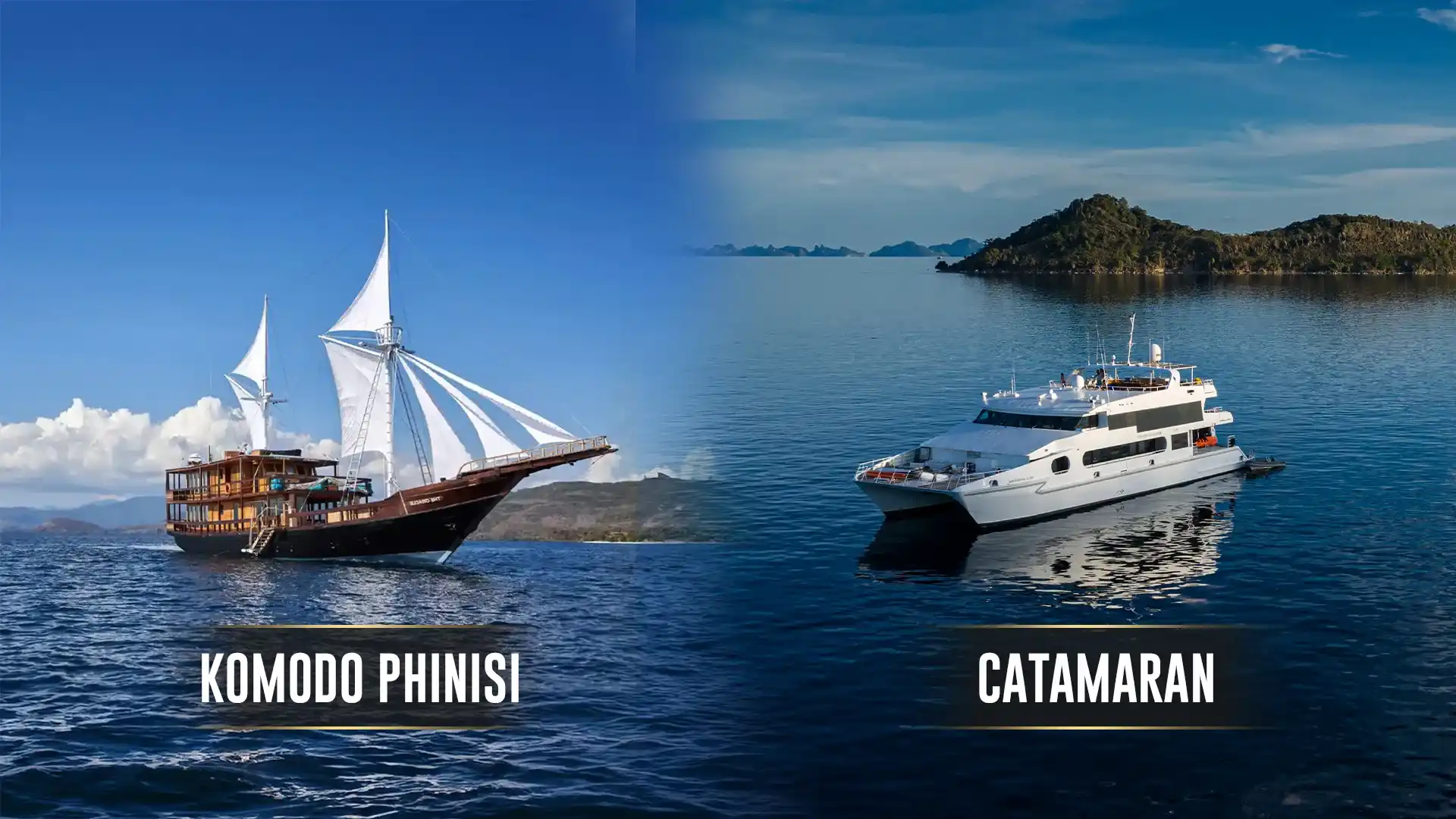
If you’re planning a multi-day yacht charter through Komodo National Park, Raja Ampat, or the Banda Sea, you’ve probably landed on the same fork in the road every traveler hits: should you book a phinisi or a catamaran?
Both are marketed as “luxury Indonesian charters.” Both show up in the same search results. Both promise turquoise water, private beaches, and Instagram-perfect sunsets. But they are fundamentally different vessels, built for different kinds of trips and choosing the wrong one can mean the difference between the trip of a lifetime and three days of feeling seasick in a cramped cabin.
This guide breaks down exactly where each vessel wins, where it loses, and which one fits your specific itinerary, budget, and travel style so you can book with confidence instead of guessing.
Phinisi vs Catamaran: Quick Comparison Table
| Aspect | Luxury Phinisi | Luxury Catamaran |
|---|---|---|
| Cruising speed | 8–10 knots | 15–25 knots |
| Cabin space per guest | Larger — single hull, deeper draft | Smaller — split across two hulls |
| Stability in open swell | Excellent — heavy wooden hull | Good, but rolls more in 2m+ swells |
| Build material | Hand-shaped Indonesian ironwood + teak | Modern fiberglass, production-built |
| Cultural heritage | UNESCO-recognized vessel (2017) | Standard production yacht |
| Dive deck | Dedicated, with rinse stations | Often retrofitted, less spacious |
| Kitchen / dining | Full galley, dedicated onboard chef | Smaller galley, often per-cabin service |
| Photography appeal | Iconic two-mast wooden silhouette | Modern fiberglass aesthetic |
| Charter cost (8–12 guests, per week) | $24,500–$120,000 | $18,000–$50,000 |
| Best suited for | Multi-day Komodo, Raja Ampat, long voyages | Bali-only day trips, fast point-to-point transit |
Why a Phinisi Wins for Most Multi-Day Charters
When you strip away the marketing photos and look purely at what happens over a 4-to-21-day itinerary at sea, the phinisi’s advantages aren’t just about heritage or looks they’re structural. A phinisi is a monohull, hand-built from heavy timber, with a deep keel that displaces water rather than skimming across it.
That single design choice cascades into almost every advantage on this list: a smoother ride in swell, more usable interior volume per guest, a kitchen and dive deck that don’t have to compromise for hull width, and a boat that was purpose-built for exactly this kind of long, open-water route rather than adapted from a design meant for calmer, shorter trips.
It also matters who’s building these boats and why. Phinisis are still constructed largely by hand in traditional shipyards in South Sulawesi, using techniques passed down through generations of Buginese and Makassarese shipwrights. That’s not a marketing footnote it directly shapes the finished vessel. Traditional builders favor thicker planking, denser ironwood frames, and hull proportions optimized for stability and cargo-carrying capacity (historically, phinisis were built to haul goods across the archipelago, not just tourists). Those same structural choices are exactly what make a modern phinisi charter feel solid underfoot in open swell, quiet at night, and spacious below deck.
Below, we break down the five specific areas where that structural advantage translates into a measurably better experience for guests on a multi-day Komodo, Raja Ampat, or Banda Sea itinerary.
1. Open-Sea Stability
Charters through Komodo, Raja Ampat, and the Banda Sea regularly cross open water where swells run 1.5 to 2.5 meters. A phinisi’s deep wooden hull and heavy displacement absorb that motion smoothly, keeping the ride steady. Catamarans, with their wider beam and lighter build, tend to roll more noticeably in the same conditions something guests prone to seasickness feel almost immediately.
2. More Livable Cabin Space
Cabin size is one of the most underrated differences between the two vessel types. A 30-meter premium phinisi typically fits 4–5 spacious cabins below the main deck, each around 3.5–4.5 meters wide. A catamaran of the same length has the same cabin count, but split across two narrower hulls cabins average just 2.5–3.0 meters wide. The difference shows up most at night: phinisi cabins feel like hotel rooms, while catamaran cabins feel more like, well, boat cabins.
3. Cultural Authenticity You Can’t Fake
A phinisi isn’t just a boat it’s a piece of living maritime history. The design carries roughly 700 years of Buginese shipbuilding tradition from South Sulawesi, and UNESCO formally inscribed the phinisi-building craft as Intangible Cultural Heritage in 2017. Guests consistently tell charter operators that this heritage factor matters more to their experience than they expected going in.
Catamarans, by contrast, are excellent modern yachts — but they’re fiberglass production vessels that could exist in the Caribbean, the Mediterranean, or Southeast Asia with zero difference in character. A phinisi only exists in Indonesia.
4. The Photography Difference
The two-masted, seven-sail silhouette of a phinisi is genuinely iconic. Drone shots of a phinisi rounding Padar Island, anchored off Pink Beach, or sailing past the karst islands of Wayag are consistently the most-shared images from Indonesian luxury charters. A catamaran looks sleek and capable, but it doesn’t carry the same visual signature and if part of your trip is about the photos and memories, that matters.
5. Better on Long Voyages (7–21 Days)
For extended trips a Banda Sea Grand Expedition, a Bali-to-Komodo crossing, or a multi-region voyage — the phinisi’s stability and quieter ride compound in your favor as the days go by. Catamarans are great for short hops, but the constant motion and tighter cabins tend to become genuinely tiring over a multi-week itinerary.
Where a Catamaran Actually Makes More Sens
A phinisi isn’t the right answer for every trip. Catamarans have three clear use cases where they outperform a phinisi.
Bali-Only Day Cruises
For 4–8 hour Bali day trips sunset cruises, Nusa Penida day trips catamarans are a great fit. Speed matters when you only have a few hours to cover 30 nautical miles, sea conditions near Bali are typically calm, and there’s no need for overnight cabin comfort.
Speed-Sensitive, Multi-Stop Itineraries
If you’re trying to combine Bali, Lombok, and Sumbawa in a tight 4–5 day window, a catamaran roughly cuts transit time in half compared to a phinisi. The trade-off is real, though: you get more time in transit and less time actually experiencing each destination.
Tighter Budgets
Catamaran charter rates typically run 25–35% below an equivalent-size phinisi. For groups that are budget-conscious but still want a proper Indonesian yacht experience, a catamaran is the more cost-effective route. (Worth noting: budget-tier phinisis also exist and can be competitively priced check our pricing page for current options.)
A Word on “Phinisi-Style” Wooden Catamarans
You may come across hybrid vessels wooden, two-hulled catamarans styled to visually resemble a phinisi. These exist, but they are not phinisis. The phinisi tradition specifically refers to vessels built using the heritage techniques of the master shipwrights of South Sulawesi’s Bira tradition, finished with the traditional two-mast, seven-sail rig. A wooden catamaran built in Thailand or Vietnam with phinisi-inspired styling is still a wooden catamaran not the genuine article. If cultural authenticity is part of why you’re chartering a phinisi in the first place, this distinction matters.
Which Boat Should You Book? A Scenario-by-Scenario Breakdown
Planning 4–7 days in Komodo, Raja Ampat, or a Bali-to-Komodo route? Book a phinisi. The combination of stability, cabin comfort, cultural authenticity, and photographic appeal makes it the clear winner. Yes, there’s a cost premium over a catamaran but for a trip of this length and significance, it’s worth it.
Planning a 1-day Bali sunset cruise or Nusa Penida day trip? Either vessel works well here, but a phinisi still edges out on atmosphere. Even for a short trip, a sunset cruise aboard a phinisi tends to be the more memorable version of the experience. (See our 4-hour Bali sunset cruises from $1,200 for the full boat.)
Planning a 14–21 day Banda Sea Grand Expedition or Raja Ampat Grand Voyage? Phinisi only. Catamarans simply aren’t built for this combination of open-water passages, extended time aboard, and multi-week cabin comfort.
Planning a dedicated diving charter? Go with a phinisi. You get a dedicated dive deck, established dive operations already built into the itinerary, and captains experienced with Komodo and Raja Ampat’s current systems. Catamaran dive trips exist, but they’re usually shorter and less specialized for serious divers.
The Bottom Line for Travelers Booking a Multi-Day Charter
For roughly 90% of travelers planning a multi-day Indonesian yacht charter, a phinisi is the superior choice. The 25–35% cost premium over a catamaran is generally offset by the heritage value, cabin comfort, open-water stability, and the photography factor that comes with it. Catamarans remain the right call for short Bali-only trips, tight multi-stop itineraries, and travelers who are prioritizing speed and a lower upfront cost over the full destination experience.
The real question isn’t “which boat is better” in the abstract it’s which boat matches your itinerary, your group’s comfort with the sea, and your budget. If you’re still unsure, the fastest way to find out is to talk through your specific dates and destination with a charter specialist who can match you to the right vessel.
Frequently Asked Questions
Is a phinisi more comfortable than a catamaran for seasickness-prone travelers? Generally yes. A phinisi’s heavy wooden hull and deep draft absorb open-sea swell more smoothly than a catamaran’s lighter, wider-beam construction, which tends to roll more in swells above 2 meters.
Is a catamaran cheaper than a phinisi for a Komodo charter? Yes, typically by 25–35% for an equivalent size and guest capacity. However, budget-tier phinisi options also exist and can close that gap.
Can a catamaran handle a Raja Ampat or Banda Sea voyage? It’s not the ideal choice. These routes involve longer open-water passages and multi-week stays where a phinisi’s stability and cabin comfort matter significantly more.
What makes a phinisi UNESCO-recognized? UNESCO inscribed the traditional Buginese phinisi shipbuilding craft not a specific boat as Intangible Cultural Heritage in 2017, recognizing the centuries-old construction techniques passed down by shipwrights in South Sulawesi.
Are “phinisi-style” wooden catamarans a real phinisi? No. They’re wooden catamarans styled to resemble a phinisi, but they don’t follow the traditional Bira-tradition construction or the two-mast, seven-sail rig that defines an authentic phinisi.
Ready to Compare Vessels for Your Dates?
Tell us your travel dates, group size, and destination, and we’ll send you matched vessel options — phinisi or catamaran based on what actually fits your trip.
WhatsApp: +62 811 382 3875 Email: [email protected]