
 Luxury Phinisi Editorial Desk
Updated: August 2026
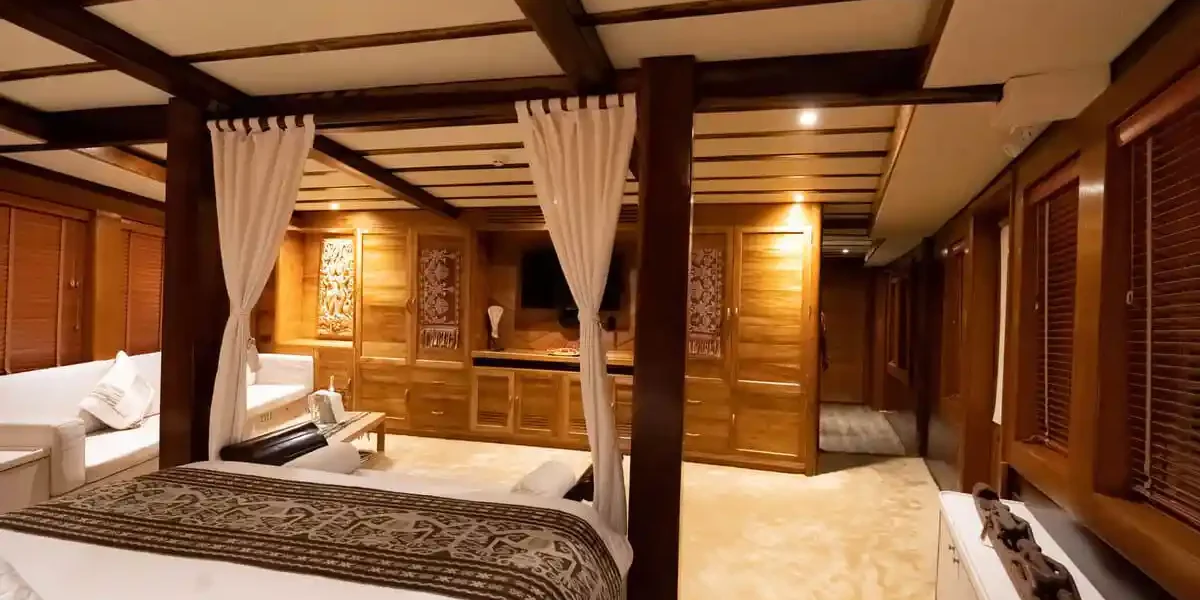
Across 40-metre-plus luxury phinisi, master cabins benchmark at 25–45 square metres with full-beam layouts, king beds oriented to stern or panoramic side glazing, dedicated dressing areas, marble or stone-composite bathrooms with rain showers, and independent climate zones. The master suite is now the single most price-sensitive space aboard.
Why the Master Cabin Sets the Price
On vessels above 40 metres, charter guests and buyers alike judge the whole ship through one room. Charter parties are typically anchored by the person paying, and that person sleeps in the master; at resale, the master suite photographs first in every listing and tours first in every viewing. Brokers see the effect directly: two 45-metre boats with equivalent hulls can separate by USD 500,000 on the strength of the owner’s suite alone. It is the room where the standards documented across our curated flagship listings concentrate.
The Dimensional Benchmarks
- Floor area: 25 square metres is the credible floor for a 40-metre boat; the strongest flagships reach 40–45 square metres including dressing room and bathroom.
- Layout: full-beam is the benchmark — the suite spans the hull, converting the vessel’s widest section into private space. Stern-cabin masters trade beam for the signature panoramic transom glazing.
- Headroom: 2.1 metres clear as a minimum through the sleeping area; the best designs hold it into the bathroom.
- Bed: a true king, oriented so the occupant wakes to water — stern windows or oversized hull glazing — not to a bulkhead.
The Finish Benchmarks
Materials in a flagship master follow the vessel’s broader design language — hand-fitted teak, natural textiles, stone — but three specifics separate benchmark suites from merely large ones. First, the bathroom: stone or marble-composite surfaces, a rain shower sized for the head sea state, and ventilation engineered so the tropics stay outside. Second, storage: a dedicated dressing area with wardrobe depth for a two-week voyage, because flagship charters are long charters. Third, acoustic and climate independence: the master holds its own air-conditioning zone and enough insulation that the generator and the saloon above are rumours, not presences. The studios executing this standard are profiled in our interiors article.
What Surveyors Check Behind the Marble
A benchmark master is an engineering object. Under the finishes, survey attention goes to ventilation routing and condensation management around the enlarged glazing, watertight integrity of hull windows and their surrounds, wiring access behind fitted joinery, and the structural framing around any full-beam opening in what remains a working wooden ship. These checks fold into the structural points of the 12-point standard — a stunning suite that compromises the hull’s integrity is a defect, not a feature, and glossy suite photography is one of the classic distractions catalogued in our red-flags guide.
Experiencing the Benchmark Before Buying
Dimensions read flat on paper; the difference between 28 and 40 square metres at anchor off Padar does not. Buyers shortlisting flagship vessels routinely charter before committing — a voyage in the actual master suite of a candidate class is the most informative diligence available and doubles as the sea trial for comfort, noise and climate performance. The flagship end of the charter fleet, including several benchmark-setting suites, books through Komodo Luxury’s charter desk, and current flagship sale candidates are presented with full master-suite documentation on our Komodo listings page.
Benchmarks Are Moving: What 2027 Deliveries Show
The master-suite standard is not static, and build slots delivering into 2027 show where it is heading. Glazing keeps growing: hull windows that would have been daring five years ago are now specified as a matter of course, with the engineering attention shifting to framing and condensation management around ever-larger openings. Climate independence is extending into acoustic independence, with owners specifying insulation packages that make the suite silent at anchor under generator load — a benchmark charter guests increasingly test on the first night. Dressing areas are absorbing office functions, reflecting owners who work aboard for weeks rather than visiting for days. And the bathroom is becoming the second signature space after the bed orientation, with stone volumes and natural light that would read as ambitious in a land villa. For buyers of existing vessels, the practical implication is a moving target: a suite that benchmarked in 2022 reads as merely comfortable against 2027 deliveries, and refit budgets should be set against where the standard is going, not where it was when the boat launched.
Frequently Asked Questions
How large is a benchmark master cabin on a 40m+ phinisi?
25 square metres is the credible minimum; the strongest flagships reach 40–45 square metres including dressing room and bathroom, usually in a full-beam layout or a stern suite with panoramic transom glazing.
Does upgrading the master cabin pay back at resale?
On flagships, yes — the master suite is the most price-sensitive space aboard, and brokers observe separations up to USD 500,000 between equivalent hulls on suite quality alone. Document the refit fully to capture it.
What is the most common master-suite defect found in survey?
Condensation and ventilation failures around enlarged glazing, followed by improvised wiring behind fitted joinery. Both are engineered out in studio-designed suites and priced into refit plans when found.
Speak With a Phinisi Broker
Current listings, sea-trial scheduling and build-slot availability are handled directly by our brokerage desk through our parent operator Komodo Luxury. Share your length range, budget band in USD and intended use — private, charter business, or both — and we respond with a matched shortlist within one working day.
WhatsApp: +62 811 382 3875 · Email: [email protected]